The chronicles of a man with cystic fibrosis just trying to live a good life.
October 3, 2013
Duke Pulmonary Rehab
I'm not going to lie: day one kicked my ass. I stuck it out, as I always do, and hopefully met their expectations for the day, but it was tiring, especially the 20 minutes I put in on the stationary bike. It's going to be hard work getting in 22 more of these sessions.
Let me back up a bit.
It is the policy of the Duke lung transplant program that all of their patients go through pulmonary rehabilitation both before and after transplant. One instantly grasps the necessity of rehab after a major surgery, but may not be so quick to realize why it is important before surgery. You see, they would like each patient to be as healthy as possible prior to surgery - strong, flexible, able to endure. The only thing that should be subpar is, of course, the lungs. So: get your ass into the gym, you wheezy weakling!
And so, having cashed out my chips at the NY Presbyterian Casino and Hotel and gone down the road to Duke, I am being put through a program I could not even have imagined. After a fairly thorough physical evaluation, including a six minute walk test, the therapists set my particular bar and off I went.
Each session of pulmonary rehab is FOUR HOURS. In that stretch of time, each patient works with weights, does stretches, floor exercises, and two forms of cardio (stationary bike and walking), all topped off with a one hour patient education class. This may vary from day to day; I'm not sure yet. (We did not have a class today, as the rehab center just moved to a new location and things are still a little crazy.)
So not only am I finding my way in a new city, finding a new facility (1821 Hillandale Road), but I'm a new patient to the staff and they're in a new building and not yet 100% up and running. It must have been slam-bang crazy for them! But onwards and upwards. Time waits for no man. Tempus fugit. Carpe diem. Keeping the patients on their road to rehab is critical.
The staff is great. Every single person seemed very en pointe and there are a LOT of staff members. You are always being watched, always being coached, and always in the nicest way. The new facility is also great. It's not huge, but it does the job while at the same time having that clean, shiny, new-gym smell to it.
So today? My first session? Let's just say I wish I'd dressed more appropriately. Tomorrow it's gym shorts and a tech-t, water bottle in one hand, high-flow oxygen cannula in the other. Because I'll be damned if I'm going to let 20 minutes on the bike make me feel like THAT ever again.
September 1, 2013
The Real Handicap Is...
This is an e-tank.
It is the most commonly used size of tank and is probably the one you think of when you picture someone on oxygen. You probably also picture the little dolly, too. The tank is 25" high and 4.38" diameter, holding 625L of oxygen when full, at a pressure of 1900 psi. There are smaller sizes (down to A tanks) and larger tanks. I have an H tank in my hallway. It is the size of a six-year-old. (Thanks to openanesthesia.org for the tank info.)
In my backpack, I carry D and C tanks (ML9 and ML6 actually, but close enough). They don't hold as much, of course, but with a conserving device, that's not generally a problem. And I can refill mine. Not so with E tanks. And let me stress: D tanks and smaller are SO much more portable. Infinitely more portable!
I make this point because I've been on oxygen for almost a year now, but it wasn't until this recent trip that I've been saddled with e-tanks. For five days I juggled 14 of them.
Now, I've gotten used to dealing with being tethered to a tank or concentrator. I've gotten used to paging my oxygen hoses as I walk around the house or office. But I have NEVER felt as handicapped as when I was wheeling e-tanks behind me. It is a whole new level of onerousness. I had always protested against the handicapped label to this point. How handicapped can I be if I can shoulder an oxygen tank and walk most any distance I want to, however slowly I may have to? But with an e-tank in tow, I started to look for closer parking spots and kinda wishing I had that handicapped parking tag.
Can't give in to that kind of thinking. I CAN walk and so I should. But man am I glad the e-tanks are gone and I'm back on my Homefill D tanks again. My supposed handicap is respiratory failure. But the very thing supposed to relieve that handicap often is what actually makes me feel handicapped. And for the most part, I didn't feel that way at all until my only portable oxygen was e-tanks in a cart. Now THOSE will handicap a person, respiratory insufficiency or no.
I'll leave my anger issues at not being able to use a POC or a Helios system for another post.
It is the most commonly used size of tank and is probably the one you think of when you picture someone on oxygen. You probably also picture the little dolly, too. The tank is 25" high and 4.38" diameter, holding 625L of oxygen when full, at a pressure of 1900 psi. There are smaller sizes (down to A tanks) and larger tanks. I have an H tank in my hallway. It is the size of a six-year-old. (Thanks to openanesthesia.org for the tank info.)
In my backpack, I carry D and C tanks (ML9 and ML6 actually, but close enough). They don't hold as much, of course, but with a conserving device, that's not generally a problem. And I can refill mine. Not so with E tanks. And let me stress: D tanks and smaller are SO much more portable. Infinitely more portable!
I make this point because I've been on oxygen for almost a year now, but it wasn't until this recent trip that I've been saddled with e-tanks. For five days I juggled 14 of them.
Now, I've gotten used to dealing with being tethered to a tank or concentrator. I've gotten used to paging my oxygen hoses as I walk around the house or office. But I have NEVER felt as handicapped as when I was wheeling e-tanks behind me. It is a whole new level of onerousness. I had always protested against the handicapped label to this point. How handicapped can I be if I can shoulder an oxygen tank and walk most any distance I want to, however slowly I may have to? But with an e-tank in tow, I started to look for closer parking spots and kinda wishing I had that handicapped parking tag.
Can't give in to that kind of thinking. I CAN walk and so I should. But man am I glad the e-tanks are gone and I'm back on my Homefill D tanks again. My supposed handicap is respiratory failure. But the very thing supposed to relieve that handicap often is what actually makes me feel handicapped. And for the most part, I didn't feel that way at all until my only portable oxygen was e-tanks in a cart. Now THOSE will handicap a person, respiratory insufficiency or no.
I'll leave my anger issues at not being able to use a POC or a Helios system for another post.
August 20, 2013
Jealousy?
I believe it is the Buddhists that have the principle that suffering is caused by want. And I have worked hard to shrink the part of my personality that wants things for purely selfish reasons. I'm not prone to be jealous of other people, or particularly avaristic or covetous. I will want things for other people, especially if I can be part of the mechanism that makes that happen. I have clear throughlines at work, for instance, where I desire a certain outcome and will work hard to get that. But that sort of want is altruistic, as it enhances the greater good.
The more selfish wants of this world quickly get wearisome. I don't really want for much that I actually need, and usually don't "need" what I think I want. If I post a picture on Facebook of a car I admire, for instance, I may have wanted it - for about a second. But the realities of ownership of that vehicle usually far outweigh the benefits of having it. So I am happy to just admire the craftsmanship and beauty in front of me. (I should be plainspoken here and say, too, that this may be how I approach relationships....and maybe that needs revision. Can I ever find myself a good partner without, at some point, coveting?)
Recently, I spotted this beautiful 1970 Cadillac DeVille Classic, wonderfully restored, near my house. Yeah, I want! I want to look at it for a long time; I want to drive it. But I don't want to HAVE it.
However, there are a couple things lately that have really pushed my WANT button and pushed it hard enough to be called actual jealousy.
One of those things is this:
No, not the pink bag. A FB friend posted this. She says that after a meeting where another patient picked up her oxygen by mistake, she decided to bling out her equipment so it couldn't be mistaken for someone else's. Great idea! Then I noticed: it's a Helios system. And the green-eyed monster took control!
Why does she get a Helios system and I can't? If they're allowed anywhere, why not everywhere? If one company does it, why not all? If one BRANCH of a company does it, why not all of them? I am struggling daily with refilling these heavy tanks and could be much happier commuting with a Helios liquid oxygen system, I assure you!
.....sigh.....
This is one of the things about this stage of CF that does suck. Working with oxygen companies is a crapshoot at best. You'd think that life-support-type equipment (and the patients needing it) would be handled a touch more professionally and supportively, especially if a particular piece of equipment allows a patient to resume the functions of a normal life. But no....dealing with oxygen companies is more akin dealing with furniture delivery people.
It doesn't help that I read this shortly after my PD1000 regulator went on the fritz and left without sufficient oxygen supply while an hour (and much walking and stairs) away from home.
The other thing that has touched off some real jealousy and which prompted this blog post, is that for the last five days in a row, I've seen morning or evening notices on FB that yet another FB acquaintance (or member of one of the transplant groups) has been transplanted. It's like the nation's transplant teams, as a whole, are settin' 'em up and knockin' 'em down like bowling pins.... and I'm feeling like I'm a bowling pin that's fallen behind some piece of machinery and forgotten. Some of these patients were in far worse condition than I, and I am not jealous of them. Other patients - other areas of the country - they were in better condition. Or same condition but waited a matter of weeks, not months or years. I don't know how the patients who have waited for YEARS and still haven't been called have managed to stay sane, because this is definitely gnawing at me.
Obviously, the common thread among these things -- the fine cars, the Helios, the operation -- is that these items are scarce. Scarcity seems to drive want. (Duh.) But my jealousy only boils up when I'm looking at a scarce item that I could have conceivably had (or will get), but is consistently denied to me for little to no good reason.
I wish all these recently-transplanted patients well, and am truly thankful transplants can even be done. Yet I'll continue to struggle to keep the green-eyed monster at bay. I'm only human, after all.
The more selfish wants of this world quickly get wearisome. I don't really want for much that I actually need, and usually don't "need" what I think I want. If I post a picture on Facebook of a car I admire, for instance, I may have wanted it - for about a second. But the realities of ownership of that vehicle usually far outweigh the benefits of having it. So I am happy to just admire the craftsmanship and beauty in front of me. (I should be plainspoken here and say, too, that this may be how I approach relationships....and maybe that needs revision. Can I ever find myself a good partner without, at some point, coveting?)
Recently, I spotted this beautiful 1970 Cadillac DeVille Classic, wonderfully restored, near my house. Yeah, I want! I want to look at it for a long time; I want to drive it. But I don't want to HAVE it.
However, there are a couple things lately that have really pushed my WANT button and pushed it hard enough to be called actual jealousy.
One of those things is this:
No, not the pink bag. A FB friend posted this. She says that after a meeting where another patient picked up her oxygen by mistake, she decided to bling out her equipment so it couldn't be mistaken for someone else's. Great idea! Then I noticed: it's a Helios system. And the green-eyed monster took control!
Why does she get a Helios system and I can't? If they're allowed anywhere, why not everywhere? If one company does it, why not all? If one BRANCH of a company does it, why not all of them? I am struggling daily with refilling these heavy tanks and could be much happier commuting with a Helios liquid oxygen system, I assure you!
.....sigh.....
This is one of the things about this stage of CF that does suck. Working with oxygen companies is a crapshoot at best. You'd think that life-support-type equipment (and the patients needing it) would be handled a touch more professionally and supportively, especially if a particular piece of equipment allows a patient to resume the functions of a normal life. But no....dealing with oxygen companies is more akin dealing with furniture delivery people.
It doesn't help that I read this shortly after my PD1000 regulator went on the fritz and left without sufficient oxygen supply while an hour (and much walking and stairs) away from home.
The other thing that has touched off some real jealousy and which prompted this blog post, is that for the last five days in a row, I've seen morning or evening notices on FB that yet another FB acquaintance (or member of one of the transplant groups) has been transplanted. It's like the nation's transplant teams, as a whole, are settin' 'em up and knockin' 'em down like bowling pins.... and I'm feeling like I'm a bowling pin that's fallen behind some piece of machinery and forgotten. Some of these patients were in far worse condition than I, and I am not jealous of them. Other patients - other areas of the country - they were in better condition. Or same condition but waited a matter of weeks, not months or years. I don't know how the patients who have waited for YEARS and still haven't been called have managed to stay sane, because this is definitely gnawing at me.
Obviously, the common thread among these things -- the fine cars, the Helios, the operation -- is that these items are scarce. Scarcity seems to drive want. (Duh.) But my jealousy only boils up when I'm looking at a scarce item that I could have conceivably had (or will get), but is consistently denied to me for little to no good reason.
I wish all these recently-transplanted patients well, and am truly thankful transplants can even be done. Yet I'll continue to struggle to keep the green-eyed monster at bay. I'm only human, after all.
August 4, 2013
The Relativity of Cystic Fibrosis
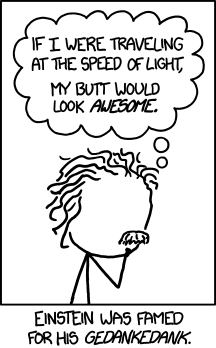
Remember in high school watching the clock on the wall and it seemed like time absolutely stood still between 3:14 and 3:15? I do. But do you really want time to stand still? Trying waiting for the last 10% of an IV to infuse when you're already 90 minutes late for bed and have to be up early in the morning. That's time travel! Albert Einstein could not have described relativity better.
There are a few things that having cystic fibrosis makes just a liiiiiiitle bit different than most people's lives. I'm not saying that makes us special, just that our experiences will never 100% jive with normal people's experiences. Or, for that matter, the experiences of people with other diseases, especially ones acquired later in life. I'd like to talk about things that come out, well, a slightly different shade of life - as if those of us with CF are moving at relativistic speeds and have red-shifted from your point of view (as you have red-shifted from our point of view). And this difference gets more pronounced the farther down the rabbit hole we go; the farther our disease takes us. A key difference is the tenor of our relationships.
Wednesday, a friend of mine whom I've known for more than a year, attended many transplant meetings with, and feel very close to -- yet have never physically touched -- finally, finally got her transplant. You know, I really thought Emily was doing OK there for a while, but then she took a sudden turn for the worse, ending up hospitalized on high flow oxygen, then ECMO... I began to worry. ECMO is a real sign that your lungs are done. Were it not for this mechanical intervention, she'd have died. And it kept her alive...for about two weeks, she waited in this state and finally she got her transplant this last Wednesday night slash Thursday morning!
I am incredibly relieved and thankful! It may be the prednisone in my system, but I broke down in tears of joy when I read the notice on her Wall. In these cases, it's always possible that lungs won't be found in time. But there was a time when I told her I was sure that though she came to the transplant program after me and was listed after me, she'd get her transplant before me. I also told her that I was sure she'd get a transplant because girls like her ALWAYS get a transplant, but that I am not so sure about myself. (Ah, but those doubts are for another blog post.)
So...why am I so invested in Emily's progress? Why is her journey, the travails of a girl I actually actually hardly know, so riveting to me? It's because, I think, those of us with CF and particularly those of us who have reached end-stage CF, feel close to one another in a way similar to what soldiers describe after surviving harrowing battles together. In very real, very concrete ways, we are more brothers and sisters to each other than our biological families. It's true! My brother and my sisters will never understand what I'm going through or what I'll soon be going through. But Emily can and does. And I understand her struggles. Same goes for Piper and Jerry and James and Kenna and Megan and dozens of others. We know precisely -- and in minute, excruciating detail -- what each other is going through. And for the few parts of their journeys I haven't already experienced, I am incredibly thankful my brothers and sisters are slightly ahead of me on their journeys, so as to shine a light on a very dark path, as I strive to shine a light on the path I've already traveled.
This, you see, is one of those relativistic differences. How many people have such an extended family? That when you gripe about coughing up green mucous with red streaks in it, that there's a chorus of "yep, been there done that"? Or when you have a question about the best way to keep from getting tangled up in your oxygen tubing while sleeping, that there's a half dozen good suggestions? Or grumble about having spent half your morning on the toilet attempting to kill every living thing in the house... Well, I honestly don't think most people can experience this. There's also the fact we've lived with this our entire lives. OUR ENTIRE LIVES. By contrast, there's damn few other people who have life-impacting conditions since birth. Most people's problems - whatever they are - came on with age, with injury, with having done something stupid, or stupidly having failed to do something. (Let's face it: as a race, most of our problems are the result of putting things of too little quality and too high quantity into our various orifices. I am sometimes....not as sympathetic as I could be towards the problems brought on by excess, as opposed to the problems brought on by genetics.)
Having CF is also somewhat like being a photon in a laser beam. We are not only on the same wavelength, we are on the same vector. And those who aren't part of the laser beam, can't even SEE the laser beam. (CF is often an invisible disease to others, but that's for yet another blog post.)
So if you find me jumping around in ecstasy over the news that my friend Emily is off the vent, or her chest tubes are out, or she's finally gone home - don't think me lunatic or overly attached. Just realize that one of my sisters has had her life spared and I'm not only happy for her, but I'm happy for all of us with this miserable disease. Her progress becomes the progress of all of us; her success, our success. Her hope fulfilled, the expectant hope of us all.
There are a few things that having cystic fibrosis makes just a liiiiiiitle bit different than most people's lives. I'm not saying that makes us special, just that our experiences will never 100% jive with normal people's experiences. Or, for that matter, the experiences of people with other diseases, especially ones acquired later in life. I'd like to talk about things that come out, well, a slightly different shade of life - as if those of us with CF are moving at relativistic speeds and have red-shifted from your point of view (as you have red-shifted from our point of view). And this difference gets more pronounced the farther down the rabbit hole we go; the farther our disease takes us. A key difference is the tenor of our relationships.
Wednesday, a friend of mine whom I've known for more than a year, attended many transplant meetings with, and feel very close to -- yet have never physically touched -- finally, finally got her transplant. You know, I really thought Emily was doing OK there for a while, but then she took a sudden turn for the worse, ending up hospitalized on high flow oxygen, then ECMO... I began to worry. ECMO is a real sign that your lungs are done. Were it not for this mechanical intervention, she'd have died. And it kept her alive...for about two weeks, she waited in this state and finally she got her transplant this last Wednesday night slash Thursday morning!
I am incredibly relieved and thankful! It may be the prednisone in my system, but I broke down in tears of joy when I read the notice on her Wall. In these cases, it's always possible that lungs won't be found in time. But there was a time when I told her I was sure that though she came to the transplant program after me and was listed after me, she'd get her transplant before me. I also told her that I was sure she'd get a transplant because girls like her ALWAYS get a transplant, but that I am not so sure about myself. (Ah, but those doubts are for another blog post.)
So...why am I so invested in Emily's progress? Why is her journey, the travails of a girl I actually actually hardly know, so riveting to me? It's because, I think, those of us with CF and particularly those of us who have reached end-stage CF, feel close to one another in a way similar to what soldiers describe after surviving harrowing battles together. In very real, very concrete ways, we are more brothers and sisters to each other than our biological families. It's true! My brother and my sisters will never understand what I'm going through or what I'll soon be going through. But Emily can and does. And I understand her struggles. Same goes for Piper and Jerry and James and Kenna and Megan and dozens of others. We know precisely -- and in minute, excruciating detail -- what each other is going through. And for the few parts of their journeys I haven't already experienced, I am incredibly thankful my brothers and sisters are slightly ahead of me on their journeys, so as to shine a light on a very dark path, as I strive to shine a light on the path I've already traveled.
This, you see, is one of those relativistic differences. How many people have such an extended family? That when you gripe about coughing up green mucous with red streaks in it, that there's a chorus of "yep, been there done that"? Or when you have a question about the best way to keep from getting tangled up in your oxygen tubing while sleeping, that there's a half dozen good suggestions? Or grumble about having spent half your morning on the toilet attempting to kill every living thing in the house... Well, I honestly don't think most people can experience this. There's also the fact we've lived with this our entire lives. OUR ENTIRE LIVES. By contrast, there's damn few other people who have life-impacting conditions since birth. Most people's problems - whatever they are - came on with age, with injury, with having done something stupid, or stupidly having failed to do something. (Let's face it: as a race, most of our problems are the result of putting things of too little quality and too high quantity into our various orifices. I am sometimes....not as sympathetic as I could be towards the problems brought on by excess, as opposed to the problems brought on by genetics.)
Having CF is also somewhat like being a photon in a laser beam. We are not only on the same wavelength, we are on the same vector. And those who aren't part of the laser beam, can't even SEE the laser beam. (CF is often an invisible disease to others, but that's for yet another blog post.)
So if you find me jumping around in ecstasy over the news that my friend Emily is off the vent, or her chest tubes are out, or she's finally gone home - don't think me lunatic or overly attached. Just realize that one of my sisters has had her life spared and I'm not only happy for her, but I'm happy for all of us with this miserable disease. Her progress becomes the progress of all of us; her success, our success. Her hope fulfilled, the expectant hope of us all.
July 22, 2013
A looming catch-22
I've been thinking lately about Vertex Pharmaceuticals. They've done such a great job so far creating CFTR correctors. There's now a drug that for 4% of CF patients is one step away from a cure. It actually restores the function of the faulty CFTR protein in these patients. And the reported results have been, for the most part, amazing. Lung function declines have stopped and in some patients function has improved. Digestion has improved. Little. Blue. Awesome.
There are trials right now testing a combination of Vertex drugs to see if the CFTR can be corrected well enough in people with my mutation: two copies of delta-f508.
But I see a problem on the horizon; and it's a problem only for a very select few patients, the ones in the same boat as me: listed for transplant.
I am actually worried that a Vertex product will be approved for double-f508d before I get my transplant. Why? Well, what if my doctor prescribes it? If I don't take it, I'm labeled non-compliant and kicked off the tx list and I die. If I do take it, and my lung function stops dropping or even improves slightly, then I'm stuck in a just-shy-of-transplant hell. Again, possibly dropped off the list if my O2 use lowers and FEV1 stays above 25%. (To be sure, I'm not convinced that's even possible. I think the physical damage is done, regardless of any PFT improvement brought about by clearing out all the mucous.) And even if I stay on the list, tethered to an oxygen source 24/7, yet able to nominally function, my Lung Allocation Score won't be rising. It'll be stuck where it is. And thus there will be an endless stream of PF and sarcoidosis (and etc) patients getting sicker than I -- I'll never reach the top of the list. I'll never be transplanted.
I am horrified when I contemplate the catch-22 that could land me squarely in a living hell. And in all of human history, this can happen ONLY AT THIS POINT IN TIME. FML.
Subscribe to:
Posts (Atom)